Content Marketing for SEO

What Is Content Marketing ?
Content marketing is a catch-all phrase to describe the use of content to attract people, convey marketing messages, and lead people to take a desired action.
One obvious example is a blog which provides content demonstrating our specialist knowledge in a given niche. We are sharing information, and we do so for free, however our underlying agenda is to engage people in order to sell our professional services or products, or our message.
One obvious example is a blog which provides content demonstrating our specialist knowledge in a given niche. We are sharing information, and we do so for free, however our underlying agenda is to engage people in order to sell our professional services or products, or our message.
Why Adopt A Content Marketing Strategy ?
Conventional marketing approaches, which may involve publishing sales copy, as seen in brochures, or on landing pages, don’t tend to provide information of high value. This type of content is usually a description or depiction of a service or product, and little more. It is disposable.
Content marketing is about creating and distributing genuinely valuable information, that remains valuable over time. It is less direct than conventional marketing, but can be considerably more effective, as many people are put off by low-value sales pitches.
In a sea of information noise, valuable content stands out. It gives us more opportunity to engage customers.
Content marketing can be cost effective. If we run a PPC campaign, we may budget $x per week, but we know that when the spend stops, so does the traffic. By contrast, if we spend the same amount producing and marketing a piece of content, we may receive ongoing visitors over time with little or no additional cost per visitor.
Content marketing is about creating and distributing genuinely valuable information, that remains valuable over time. It is less direct than conventional marketing, but can be considerably more effective, as many people are put off by low-value sales pitches.
In a sea of information noise, valuable content stands out. It gives us more opportunity to engage customers.
Content marketing can be cost effective. If we run a PPC campaign, we may budget $x per week, but we know that when the spend stops, so does the traffic. By contrast, if we spend the same amount producing and marketing a piece of content, we may receive ongoing visitors over time with little or no additional cost per visitor.
The Middle Man Is Disappearing
The invention of the printing press changed the world. It enabled the mass production of books, which up until the 1400s had been the domain of scholars. Anyone with access to a printing press became a publisher, and could spread their information far and wide, so long as they had access to a distribution network.
The Internet was an even greater invention. Not only can we publish, but we can distribute to everyone else in the world, so long as they have an internet connection, at the touch of a button. The middle-man is being disintermediated. The third-party publisher is becoming increasingly obsolete.
These people used to be the gatekeepers. The economics of distribution served as a barrier to production, even if you did have access to a printing press, or typewriter. As a result, there was a lot less published content in the past than there is today. It is now estimated that the internet consists of 5.7 terabytes of content, and it is growing rapidly every second.
Given there is so much content being produced, and only so many humans with limited time to read it, it is clearly not enough to just publish and hope people will come. Instead, we must devise strategies to actively market content in order to fulfill our business objectives.
The Internet was an even greater invention. Not only can we publish, but we can distribute to everyone else in the world, so long as they have an internet connection, at the touch of a button. The middle-man is being disintermediated. The third-party publisher is becoming increasingly obsolete.
These people used to be the gatekeepers. The economics of distribution served as a barrier to production, even if you did have access to a printing press, or typewriter. As a result, there was a lot less published content in the past than there is today. It is now estimated that the internet consists of 5.7 terabytes of content, and it is growing rapidly every second.
Given there is so much content being produced, and only so many humans with limited time to read it, it is clearly not enough to just publish and hope people will come. Instead, we must devise strategies to actively market content in order to fulfill our business objectives.
What Is Content ?
Content is whatever you choose to create.In terms of content marketing, it is content an end user will find valuable. The content you create should be the content your chosen audience will most likely respond to, and engage with.
Many people assume that they should create content first, then seek an audience. However, the most effective content marketing finds an audience first, and then works backwards to create content that meets audience demand.
Devising A Content Marketing Strategy
There are two parts to content marketing:- Creating appropriate content
- Getting your content seen
Keyword Research
We start by gauging existing demand.A great way to do this is to use a keyword research tool. There are various keyword research tools, and they all operate in much the same way. They collect keyword search data i.e. the keywords people use to search on search engines and count how many times people use certain keyword phrases. The aim is find existing streams of keyword traffic that relate to your niche.
You then build content around these keyword terms, thus satisfying demand you already know exists.
Step One: Business Analysis
The first stage of keyword research doesn’t involve a keyword research tool. The first step is to clearly define your niche and potential customers.
Imagine we’re running a wallpaper hanging business. This business has determined their customers are people who have already purchased wallpaper, or will soon do so from another supplier, but want to know how to either hang it themselves, or get someone to do it for them.
This wallpaper hanging service makes money by selling people their hanging service, or by selling them tools to get the job done themselves. These tools include seam rollers, brushes, pasting tables and instructional e-books and DVDs.
It’s important to be clear about what you offer, who your customers are, and what you want them to do. Once you have this clear in your mind, it makes it much easier to choose the right keywords. Also, you won’t waste time and money on keywords that won’t result in the action you desire.
For example, there wouldn’t be as much value in targeting terms such as “designer wallpaper” as our example business does not sell wallpaper.
Content is time consuming and expensive to create, so spending a little time on business analysis is time well spent! Brainstorm a list of keywords your customers might use. Look at your competitors sites for inspiration. Once you have a list of your chosen keywords terms
Step Two
Log into Google Keywords.
Create an Adwords account, or if you don’t wish to create an account, provide the type in characters. In the “word or phrase box”, enter a keyword from your list.

Google will show you your keyword term, plus related keyword terms, and give you an idea of how many times people have searched for each keyword term.
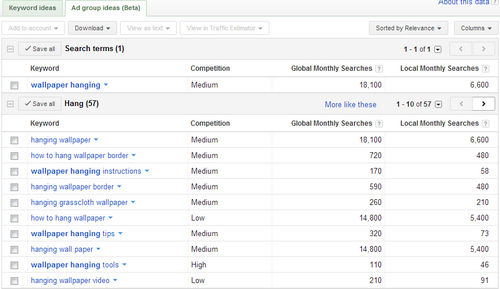
As we can see from this result, there are a number of keyword terms that would provide a great basis for our wallpapering businesses content marketing strategy. The keyword phrase “how to hang wallpaper” has around 14,800 searches per month, and gels nicely with our business case. “Wallpaper hanging instructions” only has 170 searches per month, but it might be a great term to target given this business sells ebooks providing instruction on how to hang wallpaper.
Repeat this process for all your keyword terms, thus building up a list of possible, relevant terms. These keyword terms become headings and topics for your content production.
You can, of course, use a variety of different keyword tools, which will give you slightly different information. However, don’t get too bogged down in the numbers. A rough idea of keyword volume is good enough, because you don’t yet know what content will work best in terms of achieving your business objectives.
For example, a keyword may have a high search volume, but your competitors have also noticed this fact, and have provided a lot of information on this topic. This means it’s more difficult to rank well for that term.
It’s also possible the keyword term doesn’t translate into business value. The only way to know for sure is to publish information and track results. It’s best to try and pick highly relevant terms that have existing demand but the content offered by your competitors is either non-existent, or of low-quality.
Also keep in mind that by publishing content and monitoring results via your analytics, you’ll create a rich keyword data set of your very own. Your keyword logs will reveal the search terms under which visitors have found your content. These keyword terms will likely be variations on the keyword terms you targeted and may not show up in keyword research tools. This information is gold and difficult for your competitors to acquire. This data will give you more ideas for appropriate content in future, or ideas on how to tweak your existing content to better meet visitor needs.
Trends
Other tools that can help you decide on what content to publish include trend spotting tools. Here’s a good list.
One good way to use trend data in a content marketing strategy is to look for fast breaking trends and, if they are associated with your niche, publish content on the trend topic in order to capitalize on the growing interest. This approach is particularly suited to news-driven content. Let’s look at one trend tool in a bit more detail, as it’s free and therefore readily accessible.
Google Trends
Google Trends, like the Google Keywords tool, shows how often a keyword term is searched for relative to the total search-volume across various regions of the world. This tool was split out into Google Insights For Search, but Insights has been shut down and reintegrated back into Google trends.
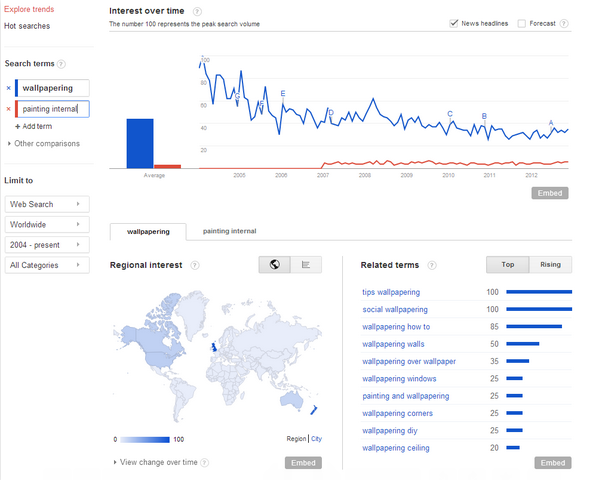
Google Trends is a great tool for comparing the relative popularity of one term against another. However, it’s most compelling use is to spot rising trends relating to your keyword area. Content that caters to a new, rapidly growing demand has a high chance of success because chances are there isn’t a lot of existing quality content on the topic yet.
We can also see which regions are most interested in these trends. For example, wallpapering appears to highly popular in the UK. This might be a good regional target audience for our company.
Another tip: look for “where do I” + keyword questions. For example, if you constantly monitor “where can I” + wallpaper in Twitter, you could respond to relevant tweets, in real time, and post your URL. It’s also a great way to gauge what is really on people’s minds. Our wallpapering company might assume people want wallpaper services and tools, yet they might spot a lot of questions about removing existing wallpaper that they hadn’t considered or emphasised.


 Posts
Posts


